Hey everyone, we’re Lindsey and Dan, full-time RV travelers exploring North America with our two doodles, Lincoln and Rocky. Through Our Life in Tow, we share the honest, unfiltered reality of what life on the road actually looks like, the good, the bad, and the surprisingly complicated.
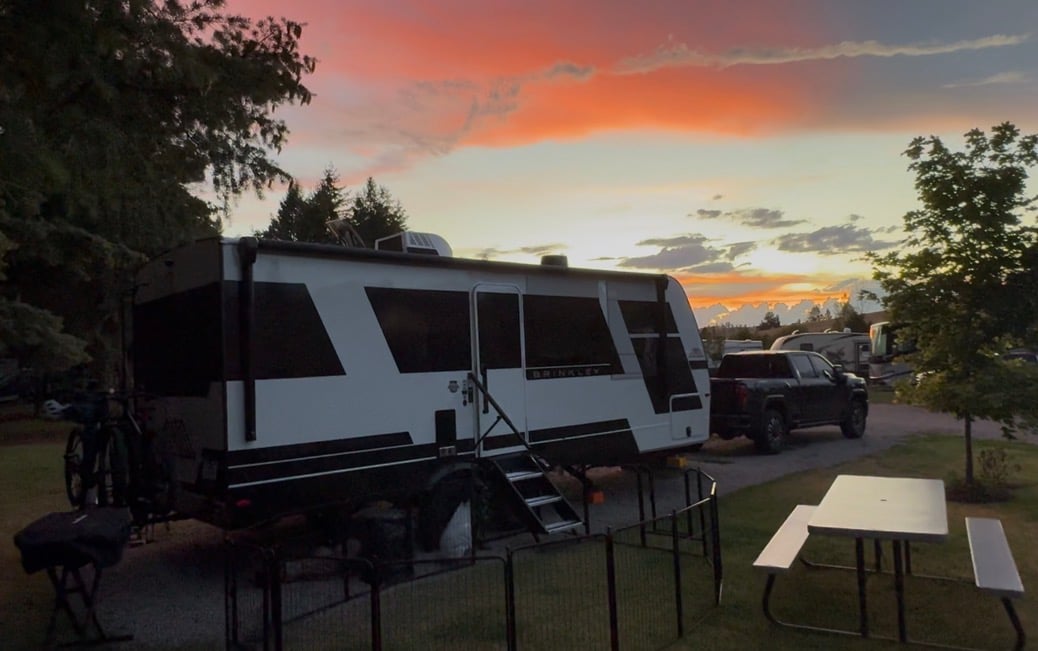
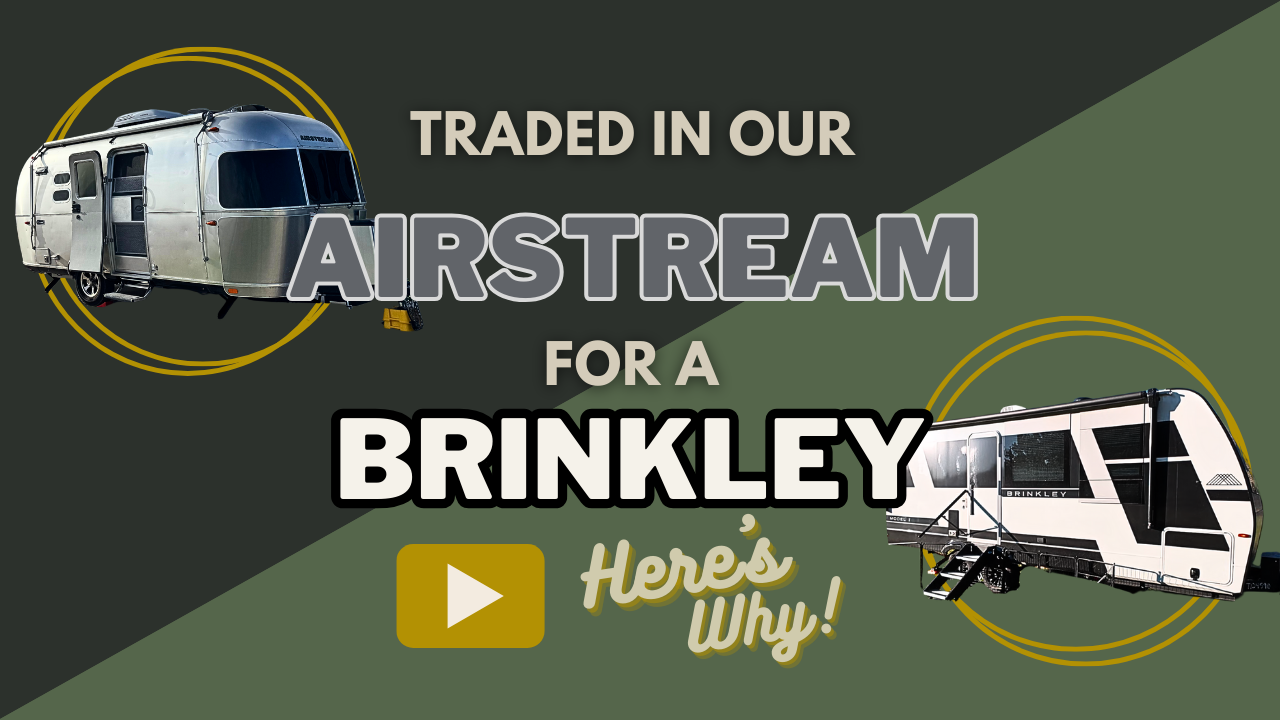
We started our adventures in an Airstream Caravel 20FB, which was perfect for weekend trips and shorter travels. But after transitioning into full-time RV life and eventually upgrading to a Brinkley Model I 235 we quickly realized two things had to change: our tow vehicle and our internet setup.
Since we both work fully remote, these upgrades weren’t luxuries, they were non-negotiable. Reliable Wi-Fi literally keeps our livelihood rolling, and a capable tow vehicle keeps our home safely behind us. Here’s the deeper story behind both decisions, and how they’ve made full-time RV life smoother, safer, and a lot more stable.
The Tow Vehicle Upgrade: Increasing Our Safety Margin
When we first looked at the Brinkley I-235, it was marketed as half-ton towable. On paper, that sounded manageable. But after digging into the numbers, we realized that while some 1500-series trucks can technically tow it, they’d be operating right on the edge of their limits. And when your home is on wheels, “just enough” isn’t enough.
Dan did the math (as he always does):
-
Loaded Weight: The Brinkley comes in around 8,500 lbs loaded.
-
Hitch Weight: Roughly 1,100–1,200 lbs on the tongue.
-
Total Payload: Once you add a heavy hitch, gear, passengers, and two dogs, you’re looking at roughly 1,600 lbsof payload — almost the entire limit for most half-tons.
-
Tow Capacity: While our old GMC Sierra 1500 AT4 could pull it, we’d be operating around 77% of towing capacity. Most experts recommend staying closer to 70–75% for safe, comfortable towing.
That margin just didn’t sit right with us. Between braking, suspension strain, and long-term wear, we knew we needed something built for heavier loads and greater stability.
Enter our new 2024 GMC Sierra 2500 Denali Ultimate. It’s strong, comfortable, and feels like a dream to tow with. We’ve put around 3,000 miles on it so far, and it’s been rock-solid, smooth handling, zero sway, and plenty of power to spare. Plus, those massaging seats (level 3 with heat!) might be our favorite discovery since joining the full-time RV world.
It’s a serious upgrade, but also one that gives us room to grow. This truck can handle almost anything we might tow in the future and most importantly, it gives us the safety and confidence to keep exploring without limits.
Our Internet Upgrade: Starlink Performance Kit
Working full-time from the road means reliable internet isn’t optional, it’s our livelihood. Dan spends most of his day running client calls and live product demos, so a stable connection is mission-critical.
When we first hit the road, we used the Starlink Mini, a compact setup about the size of a sheet of paper. It worked great for casual browsing and streaming, but we quickly ran into limitations during our full-time trial in New Hampshire.
The Mini’s Limitation: Upload Speeds Matter
The Starlink Mini averaged 90–120 Mbps download, which sounds great, but the upload speeds (7–20 Mbps) just couldn’t keep up. On video calls, Dan would freeze mid-sentence, drop out, or deal with lag and pixelation.
Video conferencing depends far more on upload stability than most people realize. Even though platforms advertise that only 2–3 Mbps is needed, the truth is you need consistent 15–20 Mbps minimum for smooth, reliable calls.
If the Mini struggled on the East Coast, we knew it wouldn’t hold up in the remote places we wanted to visit. That’s what led us to our next big upgrade, the Starlink Performance Kit.
The Starlink Performance Dish: Why It’s Worth It
After plenty of research (and field testing), we decided the Performance Kit was the only setup that truly met our needs. It’s been a complete game changer for working and streaming from anywhere.
Here’s why:
-
Speed & Stability:
The Performance dish delivers 200–300 Mbps down and 20–30 Mbps up in real-world use. That’s night and day compared to the Mini’s upload bottleneck. Starlink rates it up to 470 Mbps down and 48 Mbps up, so we’re future-proofed for faster speeds as coverage expands.
-
Durability & Weather Resistance:
With an IP69K rating, the Performance Kit is built to withstand extreme weather, high-pressure water, and salt exposure. The all-aluminum body and heavy-duty connectors give us confidence mounting it permanently on our roof even through storms.
-
Seamless Power Integration:
It can run off AC or DC power, meaning we can hardwire it directly into our batteries. If we lose shore power or switch to solar, our internet stays live, no generator or inverter required.
-
Field of View & Future-Proofing:
The wider 140° field of view helps maintain a connection even with partial tree coverage or terrain shifts. Plus, it’s engineered to handle gigabit speeds once Starlink rolls those out in 2026, no hardware swap needed.
-
Low Latency & Jitter:
The dish is optimized for stability, meaning fewer dropped frames, clearer audio, and smoother video calls, especially critical for remote workers.
For weekend travelers or casual users, the Mini or Standard dish might be plenty. But for us, running two businesses, streaming content, uploading videos, and taking back-to-back calls, the Performance Kit has been worth every penny.
Final Thoughts
Full-time RV living isn’t just about travel, it’s about creating a life that works from anywhere. For us, that means having the right tools to keep our home safe on the road and our work stable online.
Upgrading to the GMC Sierra 2500 Denali Ultimate and the Starlink Performance Kit gave us exactly that safety, comfort, and the ability to stay connected no matter where we are.
After 1.5 months and 3,000 miles in our Brinkley, we’re more confident than ever in our setup. These upgrades weren’t just about convenience they’re what make this lifestyle sustainable for us long-term on the road.
Our life in tow isn’t just about the rig or the miles, it’s about freedom, connection, and building a life that moves with us.